Monday, 6 November 2023

Sale of business interest tangled in state ACL twist

The Australian Consumer Law scheduled to the federal Competition and Consumer Act applies to corporations engaged in trade or commerce.

The Australian Consumer Law (Queensland) adopts the federal Act and applies it to non-corporations engaged in trade or commerce by operation of the state’s Fair Trading Act. Similar laws in other states likewise apply the federal Act.

Sale of business interest tangled in state ACL twistWhat hasn’t been adopted in Queensland and other states are the various qualifications that apply to the federal ACL that are buried in the Competition and Consumer Act.

The significance of absence of CCA qualifiers was recently demonstrated in a dispute relating to the sale of an interest in a business where it was alleged that individuals had engaged in misleading and deceptive conduct.

Zhiren Li and Baotong Liu signed up in September 2016 for the purchase an interest in Forever Exotic – an online and pop-up retailer of natural skin, health and home products – from Zoe Mikkelsen.

Ms Liu had been attracted to the business because the salt lamps her daughter Scarlett had acquired from it proved successful in treating her hay fever symptoms.

Mikkelsen’s husband Jan proposed the incorporation of a business of the same name with Li and Liu being issued 36 of the 100 shares in the company in exchange for $630,000.

That share issue valued the business at $1.75 mil.

Jan Mikkelsen claimed – according to the buyers – that the business had consistently achieved a net profit margin of approximately 30% and that for FY 2016, profit was approximately $400,000.

A “profit and loss cash statement” said to contain “unadulterated figures from last year” and showing a net profit of $392k on revenue of $1.4 mil was provided by Jan to Scarlett who passed it on to the buyers.

Li and Liu inked the share sale agreement Scarlett translated for them without seeking independent accounting advice.

They also contributed $60,000 by way of working capital to help fund a proposed expansion into Asia.

The business did not perform as the buyers claim they were led to believe it would.

They sued the Mikkelsens for having engaged in conduct that was misleading or deceptive, or was likely to mislead or deceive in trade or commerce and alternatively, for negligent misstatement.

The Mikkelsens defended the claims on the basis that several other financial documents – depicting lower turnover and profit – had been produced to the buyers before they signed up to the deal.

BAS statements for example showed turnover reduced by 50% and profit reduced by about 25%.

Business Valuation Specialist, Victoria Wheeler assessed the actual FY 2016 net profit of the business at just $23,000, 4.61% of turnover and testified that in most prior years it had sustained a loss.

Jan Mikkelsen argued that another $100,000 of cash sales not recorded on their “official books” should be added to those figures.

The trial judge accepted the plaintiff’s account of the profit percent representations they had relied on that had been made by Jan and that the actuals were far lower.

He also ruled that although Mr Mikkelsen was not himself or herself engaged in trade or commerce, the statements in the financial documents he provided were made “in trade or commerce” because they were designed to encourage others to invest in the trading entity.

The trial judge concluded that the buyers would not have proceeded with the investment had the defendants not made the representations and ordered Zoe Mikkelsen pay compensation pursuant to ACL s 236.

The sum they were directed to repay was the $630,000.00 purchase price discounted by 15% by reason of s137B of the CCA to account for their contributory negligence in having failed to engage an expert accountant for due diligence.

The defendants must refund the sum of $535,500.00 (plus interest) to the plaintiffs with costs.

Both parties appealed.

The Victorian Court of Appeal rejected the Mikkelsens’ arguments that the buyer had not relied on the inflated and erroneous profit representations.

It upheld the buyers’ contention that the case should have been decided under the Australian Consumer Law (Vic) because the parties who engaged in the misleading and deceptive conduct – Mr and Mrs Mikkelsen – were natural persons.

It followed that CCA 137B could not apply because there no equivalent in state ACL Acts.

Thus the contributory negligence deduction to the s 236 damages was reversed and the Mikkelsens were ordered to pay the buyers the total $630,00 investment.

Mikkelsen v Li [2023] VSCA 255 Ferguson CJ, Beach and McLeish JJA, 26 October 2023 


from
https://qldbusinesspropertylawyers.com.au/blog/sale-of-business-interest-tangled-in-state-acl-twist/


from
https://qldbusinesspropertylawyers0.weebly.com/blog/sale-of-business-interest-tangled-in-state-acl-twist


Thursday, 21 September 2023

Misleading financials: cheating the ATO or deceiving his buyers?

A business owner who provided potential buyers with impressive financial accounts that differed from the loss-making figures he had filed with the ATO has been ordered to refund the purchaser $2,150,000 of the buy price as a consequence of the misleading financials.

In early 2018 Bing Hu and Cindy Qiu were investigating the potential purchase of the café business at Melbourne’s Royal Children’s Hospital that was on the market for sale for $2.5 million.

They received financial statements from the seller recording annual profits of $502k in 2016 and $542k in 2017 and a projected profit of $530k for 2018.

John Zhang of seller Melbourne Café Pty Ltd was firm on his price but agreed to sell the business in April 2018 to Hu and Qiu’s company H & Q Café Pty Ltd, for $2.4 million.

Settlement occurred in November 2018 with the purchaser funding the buy with a loan from CBA bank.

In February 2019, Qiu discovered “hidden” records on a computer that had been acquired as part of the sale indicating losses of $174k and $265k for 2016 and 2017 and a projected profit for the 2018 year of around $150,000.

The “hidden” records – which had never been disclosed to the buyer – were consistent with the information provided by the Seller to be ATO.

The business traded poorly and in December 2019 when it was put up for sale through a broker, the only purchase offer received was at $250,000.

H & Q commenced proceedings in the Victorian County Court seeking a refund of the purchase price for the business, together with lost profits, trading losses and interest on the CBA loan.

It argued that had it been informed of the true financial position of the business, it would not have entered into the deal.

Zhang unsuccessfully contended that the “represented” financials depicted the correct financial position of the business and that the lodged tax returns for 2016 and 2017 were inaccurate.

He was found to have destroyed documents relevant to the business’ performance pre-acquisition and to have otherwise behaved deceitfully.

Zhang ultimately accepted in cross-examination the falsity of the information provided to the buyer.

The trial judge also took Ms Qiu to be an untruthful and unreliable witnesses. H & Q had concealed the poor trading performance from the CBA – in fear of its reaction – and supplied them with false information indicating a net profit of $175k for the period October 2018 to June 2019.

Against that background, the judge was required to assess what damage the buyer had suffered.

H&Q relied on expert evidence from CFAS chartered accountant Michael Smith who arrived at a value as at the date of sale – based on the “represented” misleading financials – of between $1.75 and $2 million. Victoria Wheeler of Munday Wilkinson – for Zhang arrived at a range between $2.28 and $2.57 million.

Smith valued the business on the “hidden” financials at the date of sale at nil. He also returned a nil value based on post- acquisition trading and an operating loss during H&Q’s tenure of $623k.

Wheeler was not asked to provide a figure based on the “hidden” financials but her value for the café business post- acquisition came in at between $92,000 and $103,500 with an operating loss over the period of $401k.

The judge was not convinced that the losses were attributable to the seller’s misleading representations.

“There seems to be a myriad of reasons why the business was not operating as successfully as it had been hoped.

Based on the same observations, she ruled there was insufficient evidence to assess true value of the business as at the date of acquisition. She therefore awarded only nominal damages for the buyer’s reliance on the misleading financials.

On appeal, the court did not disturb the judge’s conclusions as to Qiu’ lack of credibility as they were “neither glaringly improbable nor contrary to compelling inferences”.

It noted that Zhang’s evidence was “breathtakingly disingenuous”.

“One is left with the distinct impression after reading the transcript that he would say anything regardless of its veracity if he perceived that it improved his position,” the court’s judgment reads. “To the ATO in 2017 the business was a loser; to the prospective purchaser it was a winner. His evidence was in exactly that vein”.

Neither did they disturb the nil damages ruling in relation to operational losses since acquisition, holding that the trial judge was entitled to have concluded that those losses could have arisen for a “myriad of reasons”.

The position in respect of loss on the purchase of the business was though – they ruled – “considerably different”.

They had no hesitation in deciding that the true value of the business at the time that it was purchased by H & Q was either nil – based on accountant Smith’s evidence which ought to have been accepted – or $250,000 (based on the offer to purchase the business).

“Doing the best it could on the evidence adduced at trial”, the court – in adopting “a common sense approach” – the value of the business at the time of acquisition was $250,000.

The appeal judges assessed damages at $2,150,000, being the difference between that sum and the purchase price.

H & Q Cafe Pty Ltd v Melbourne Cafe Pty Ltd & Anor [2023] VSCA 200 Niall, Kennedy JJA and J Forrest AJA, 25 August 2023


from
https://qldbusinesspropertylawyers.com.au/blog/misleading-financials-cheating-the-ato-or-deceiving-his-buyers/


from
https://qldbusinesspropertylawyers0.weebly.com/blog/misleading-financials-cheating-the-ato-or-deceiving-his-buyers

Tuesday, 19 September 2023

Asset lending can be unjust; compounding interest unconscionable

“Asset loans” – at very high interest rates – are particularly attractive to financially distressed borrowers who are not eligible to obtain a bank loan.

Those borrowers are often over-optimistic about their own capacity to make high repayments and the lender is rarely interested in that capacity as long as the asset they are putting up as security will cover what will have to be paid in the event of a default.

Asset lending may be unjust; compounding interest unconscionableOnce the lender increases the rate – in response to Reserve Bank rises – and other ordinary living costs sharply increase, borrowers can find themselves in an inescapable trap.

In August 2018, Thuc Tran Huynh and Chau Quach borrowed $140,000 from a private lender on second mortgage security over a house in Fairfield.

The loan – which was to finish construction of their own home, also in Fairfield – was subject to interest at 4% per month, compounding monthly and escalating to 6% per month in the event of default.

Unsurprisingly, the borrowers did not repay the principal on the due date in November 2018.

Demands were issued but the mortgage was not registered until September 2019 and recovery proceedings were not filed until September 2022.

Those proceedings claimed an amount which by September 2023 had escalated to almost $1.4 million of which $1.119 million was interest.

In their defence, the borrowers claimed the transaction terms were absent from the documents they signed; that the interest at the higher rate of 6% per month was a penalty and unenforceable; and that the delay in enforcing the mortgage was itself unconscionable given interest was still compounding at 72% p.a.

They also counterclaimed to the effect that the lender’s conduct was unconscionable pursuant to ACL s 21 on the basis that what was said to be an “Asset Lend”, was unfairly designed to increase the borrowers’ debt.

Justice David Davies  sitting in the NSW Supreme Court rejected the contentions that a high rate of interest of itself made the transaction unconscionable or that asset lending per se, fall into that category.

“The system of asset-based lending could have been attractive to financially distressed borrowers who were not eligible to obtain a loan in the ordinary way,” he observed.

Such loans, he noted are likely to be “paid off by sale or, far more likely, refinancing”. And if interest is paid upfront, “an enquiry about whether the borrower had sufficient income to service the loan would be pointless”.

He observed though that asset lending may have features that were unjust.

High rates in combination with monthly compounding was a feature that in this case – he concluded – supported a finding of unconscionability, that left it open to the court to grant relief.

The court altered the terms to prevent monthly compounding but allowed the lender to recover the principal plus simple interest at 6% per month, ie 72% per annum for 5 years, $504,000. This was some $600,000 less them the interest the lender claimed but still a whopping amount in comparison to the sum borrowed.

The judge dismissed the argument that the interest rate particulars were missing from the mortgage documents at the time they were signed by the borrowers and the submission that the delay in instituting the recovery proceedings – thereby allowing the lender to continue to charge interest at 6% per month – was unconscionable.

Ledinh Sovereign Super Pty Ltd v CT Stone Pty Ltd [2023] NSWSC 1079 Davies J, 15 September 2023 Read Case


from
https://qldbusinesspropertylawyers.com.au/blog/asset-lending-can-be-unjust-compounding-interest-unconscionable/


from
https://qldbusinesspropertylawyers0.weebly.com/blog/asset-lending-can-be-unjust-compounding-interest-unconscionable

Monday, 18 September 2023

Encroachment of neighbours garage: court orders land transfer

Agnieszka and Pawel Wardanski’s home at 10 Cynthia Crescent, Springwood that they acquired in 2003, adjoined that of Karen Mawby and Scott Marks who acquired their residence in 2014.

Neither conducted a survey to confirm the boundary line between the properties or that the boundary fence – constructed decades earlier – was in the correct position.

Encroachment of neighbour's garage: court orders transfer of landFor several years, they lived happily next door to each other, each in the mistaken belief that the fence sat precisely on the boundary.
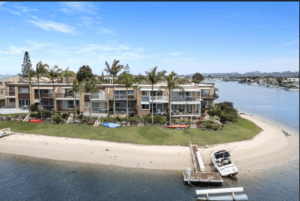
When Mawby/Marks began renovations on their property in July 2017 it was discovered in the course of a survey that the Wardanski property extended beyond the fence line and includes part of the land former believed was theirs.

They kept the matter to themselves for about 12 months until they met with their neighbours to seek consent for boundary works  purportedly at the request of their builder.

What they proposed was an easement that would have allowed the encroaching structures to remain but withheld the survey plan from the Wardanskis so as not to reveal the extent of the problem.

Realising what was afoot, Wardanski demanded the removal of the encroaching structures – a retaining wall, garden shed, gardens and part of a garage – and for the area of land of about 9 m2 extending along the entire 30m common boundary to be surrendered.

Mawby/Marks on the other hand – because of the huge costs they would incur in removing the encroachment – proposed a boundary realignment, which would allow them to acquire that part of the Wardanski land on which the encroachments stood so that those structures – and further improvements that continued to conduct – could be retained.

Project manager Beverly Hollands estimated the removal cost on their behalf, at $221,013, plus GST.

Wardanski then set about designing improvements – a garage – to take advantage of their newly-discovered land holding. They requested builder Kent Jenner identify the costs of that renovation as well as the estimated costs their neighbours would incur to remove the encroachment.

In August 2019 with no agreement in sight, Wardanski’s lawyers demanded the neighbours ‘cease and desist’ carrying out any repairs and refurbishments to the encroaching structures.

When that was largely ignored, they applied to Queensland’s Supreme Court for an order pursuant to s 185(1)(c) of the Property Law Act for the encroachments to be removed and in the alternative $185,000 for the costs of modifications to the design and construction of their garage and other losses.

It was not in dispute that Mawby/Marks were liable for the encroachment notwithstanding it had been “inherited”.

They contented that Wardanski never held any intentions to build a garage or deck extension and that it was simply a ‘device’ to justify removal of the encroachment.

While rejecting that submission, Justice Lincoln Crowley was of the view that the plaintiffs’ insistence on the removal of the encroachment so they could build their proposed garage and their unwillingness to consider potential alternative solutions that did not involve demolishing or moving the neighbour’s garage, to have been unreasonable.

He accepted the evidence of civil engineer and project manager Bradley Schaper that it is feasible for the Plaintiffs to construct an adequately sized, enclosed double car garage on their property – albeit absent the storage they desired – without removal of the neighbour’s garage.

While their rejection of the neighbour’s settlement offers was a continuation of their unreasonable conduct, the judge noted the matter was not to be determined, “by deciding whose conduct has been the most virtuous”.

“Whilst I am mindful that the Plaintiffs are the owners of the land and that their property rights ought not be lightly interfered with,” he ruled “it is abundantly clear in this case that the prejudice that to the Defendants – as ‘largely innocent encroachers’ – by an order for removal of the encroachment outweighs the prejudice that to the Plaintiffs if no such order were made”.

He ordered that Mawby/Marks pay Wardinski $16,087.50, being three times the unimproved capital value of the land burdened by the encroachment which was to be transferred to them and $5,000, for the resulting diminution in the value of their property.

There was also a retaining wall that a builder had constructed negligently on part of the Wardinski land. The court considered that to be de minimus, ie so trivial that it was of no concern.

Wardinski requested in relation to any land transfer, that it be of the total 19m2 piece of land, being the area between the existing fence and the true boundary.

Justice Crowley rejected that submission holding that the Court’s power under s 185(1)(b) is limited to ordering the transfer of the land over which an encroachment extends.

Wardanski & Anor v Mawby & Anor [2023] QSC 136 Crowley J 18 August 2023


from
https://qldbusinesspropertylawyers.com.au/blog/encroachment-of-neighbours-garage-court-orders-transfer-of-land/


from
https://qldbusinesspropertylawyers0.weebly.com/blog/encroachment-of-neighbours-garage-court-orders-land-transfer

Wednesday, 6 September 2023

Gold coast unit owner battles for long standing exclusive use

Can the owner of a community title lot – in the absence of a formal exclusive use resolution – justify improvements constructed on adjacent common property by demonstrating they were sufficiently authorised as part of the original scheme?

“Malibu” is an iconic community titles scheme in Aquila Court, Mermaid Waters on the Gold Coast established by way of a group titles plan in 1978.

Gold coast unit owner battles for long standing exclusive useIt is comprised by eight adjoining two-storey townhouses that each back onto a spectacular canal outlook.

Over the years various lot owners made improvements in the form of decks and extensions that encroach onto common property.

In mid-2018 Nicholas Hronis – who acquired his lot one year earlier – installed a security gate and an enclosed sundeck that were later ordered to be removed because of such an encroachment.

After removing his additions as per the order, he retaliated  by complaining about those made by most other owners and in particular those of his immediate neighbours Stuart Tume and Talia Marques, the owners of lot 8.

He argued that their rear deck backed onto the common property and their upper deck encroached into common property airspace.

Moreover, the railings and balustrades associated with those structures essentially cut of all of the common property at the rear such that it was ‘exclusively occupied’ by lot 8.

On Hronis’s application, the couple were ordered in June 2021 – at the height of Covid restrictions when they were stuck in New Zealand – by a Body Corporate and Community Management adjudicator to remove the patio and upper deck and to reinstate the affected rear common area lawn.

They appealed the adjudicator’s decision pursuant to s 289 of the BCCM Act to the QCAT appeals tribunal.

They argued that they had been denied the opportunity to provide additional material to the adjudicator for his consideration by reason of the delay they had encountered in receiving it due to the COVID lockdown.

The lot 8 owners argued before Senior Member Graham Traves that the patio and upper deck were built by the original owner in about 1980 as “original components of the scheme” in accordance with the original group titles plan, architects’ drawings and a 1999 general meeting approval for the construction of the sundeck.

Ms Marques also appeared in QCATA on behalf of the Body Corporate in her capacity as chairperson and presented minutes of its March 2023 AGM as submissions.

Member Traves concluded that in the absence of evidence to the contrary, the adjudicator was entitled to find that the encroachments must have been made after the original construction and were not protected by any approval granted on inception of the scheme.

He declined to allow the introduction of the plans etc as “fresh evidence” but agreed Tume and Marques had been denied procedural fairness by reason of the adjudicator’s “failure to circulate evidence to the parties that he had gathered and submissions he had received.

Observing that QCATA is strictly required to determine the appeal on the material that was before the adjudicator, he observed it could – pursuant to s 294 of the BCCM Act – also “exercise all the jurisdiction and powers of an adjudicator under the BCCM Act” and has power under QCAT Act s 146 to set aside an adjudicator’s decision and require it to be reconsidered.

With that in mind he resolved that the denial of procedural fairness constituted an error of law warranting the June 2021 decision to be set aside and the remitting of the dispute for re-consideration.

Given the critical records were not accessible to the lot 8 owners at the time of the BCCM adjudication despite their reasonable effort to obtain them, he directed a re-hearing of the dispute.

Member Traves also rules the adjudicator was required to consider the additional and “apparently credible” evidence that Mr Tume and Ms Marques had produced that they believe will save their patio and deck from destruction.

Hronis v Body Corporate for Malibu CTS 22174 & Anor [2023] QCATA 101, Senior Member Traves


from
https://qldbusinesspropertylawyers.com.au/blog/gold-coast-unit-owner-battles-for-long-standing-exclusive-use/


from
https://qldbusinesspropertylawyers0.weebly.com/blog/gold-coast-unit-owner-battles-for-long-standing-exclusive-use

Sunday, 30 July 2023

Court upholds agents boozy lunch site introduction commissions

A property consultant who “sourced” early learning centres for investors at a fee of $2000 per approved child place has fended off allegations he was working unlicensed as a real estate agent to recover $1.2 million in site introduction commissions.

Hilton Headley – whose previous experience at Colliers, JLL, Macquarie Group, Stockland and Colorado ensured he had a wide network of industry connections – had let his commercial real estate licence lapse in May 2014.

Court upholds agent's "boozy lunch" site introduction commissionsHe understood the use of his personal relationships to connect experienced childcare operators such as Guardian and Kids Club Childcare with agents and developers did not require any license.

At an encounter at the Woollahra Hotel with former Stockland colleague Glenn Dumbrell in September 2017, Headley told the nascent ELC developer that he was “happy to steer” further opportunities his way for the same fee he charged others in the industry.

Their renewed association developed quickly.

Within days, Headley provided Dumbrell and his financial backer Simon Larcombe the first deal they would consummate, a 94 place childcare centre at Hurstville.

The trio discussed the terms – $2000 plus GST “per kid” with half payable on signing a lease and the balance on opening of the centre – at a “boozy lunch” over several hours at the Woollahra Hotel’s Bistro Moncur.

Headley knew Larcombe as a school friend of his younger brother and hence did not seek any written confirmation of the terms.

Following the execution of an agreement for lease and development approval for the Hurstville site in June 2018, Larkham’s company paid 50% of Headley’s asking fee based on a downsized occupation of 72 children.

Headley sourced a further seven sites in the ACT – through Burgess Rawson’s Guy Randell – that Larcombe’s company took on.

By the end of 2019 – after Headley had received close to $500,000 in first stage payments for his introductions – Larcombe became frustrated with the delays being encountered on developer compliance with DA conditions and getting the centres opened.

He proposed revised payment terms for each site, ranging from $500 to $1,650 “per pax” and “drop dead” dates for premises construction to begin.

Under financial pressure of his own, Headley contemplated accepting the revised terms to ensure immediate payment, actions which Larkham interpreted as acceptance.

Notwithstanding payment of reduce some, Headley filed proceedings to recover his full entitlement under the original terms.

Justice Rees accepted that an agreement had been reached at Bistro Moncur or shortly thereafter substantially in the terms that Headley alleged noting that such terms had been observed by Larcombe until he made his counterproposal.

The judge also rejected the contention that Headley was bound by his “agreement” to accept a lower fee noting that the absence of any consideration other than that which was by its nature “illusionary”.

He closely examined Headley’s activities in relation to each property that he “sourced” and concluded that the introduction of particular properties on behalf of a developer or to an investor met the requirements of “carrying on business of real estate agent”.

Because he had though in respect of the ACT sites worked through Mr Randall – himself a licensed agent who conducted all of the interaction between the relevant parties – such introductions were not in the capacity “of an agent” thereby avoiding the consequences of the NSW real estate licensing requirements.

That was not the case in respect of Hurstville meaning – had the first payment not be made – that Headley would have been prohibited from recovering it. That said, Justice Rees declined to order that he be required to refund it. There was no dispute in respect of the second tranche of the Hurstville fee because the deal had been abandoned and Headley had not invoiced for the balance.

The court ordered that Larcombe’s company pay Headley a total of $750,000 for the further sites he had “sourced” in respect of which leases had been executed and noted that a further sum of $418,000 would be payable on the opening of three further centres.

Note that in Queensland the mere “introduction” of properties to a prospective buyer, lessee or seller does not appear to be an activity that requires a real estate licence if the introducer does not engage in any negotiation. That said, courts have in the past taken a broad approach to what they considered to be “carrying on business” as a real estate agent.

White Pointer Investments Pty Ltd v Creative Academy Group Pty Ltd [2023] NSWSC 817 Rees J 25 July 2023 Read case


from
https://qldbusinesspropertylawyers.com.au/blog/court-upholds-agents-boozy-lunch-site-introduction-commissions/


from
https://qldbusinesspropertylawyers0.weebly.com/blog/court-upholds-agents-boozy-lunch-site-introduction-commissions

Wednesday, 26 July 2023

Court declares 95% of lenders fees to be penalty charges

In June 2022 Steve Saad borrowed $60,000 – including loan establishment fees and legals – from a private lender and entered into a loan agreement that required repayment in full within 2 months.

An additional amount was advanced by lender First Cash Flow Solutions the following month to bring the total principal up to $86,000.

Court declares 95% of lender's fees to be penalty chargesInterest – for on time weekly payments – was at the “lower” rate of 2.15% per month but escalated to the “base” rate of 4.00% per month if overdue. Arrears were capitalised and attracted interest at the higher “base” rate.

The agreement specified a raft of other charges including a $33 monthly administration fee and a payment default fee of $1,100 if sums were not received by “within 48 hours of the due date for payment”.

The breach of any of the several banking covenants – whether of trivial or serious consequence to the lender – triggered other obligations.

At the same time as signing up the loan agreement and a second mortgage over his home as security, Saad executed two documents waiving the right to take legal advice and to take financial advice.

The borrower made his first two interest payments but thereafter went into default prompting First Cash’s termination of the arrangement in August 2022.

It thereafter notified Saad he was obliged to pay additional fees by reason of the default including a “risk fee” of 2% per month on the total outstanding and a default management fee of $440 per week.

After NAB sold up the property for $870,000 in April 2023, the amount left to satisfy First Cash’s second mortgage was some $14,000.

It filed a summons in November 2022 to recover $142,395 which – by the time the matter came before Justice Stephen Robb in the NSW Supreme Court in May 2023 – had ballooned to $222,200 and included $136,000 in interest and charges.

Notwithstanding Saad had filed no defence and did not appear at the hearing, Justice Robb required First Cash to justify its claim and to overcome the presumption that the weekly default fee – because it imposed on the borrower same cost for both serious and trivial breaches – was a penalty.

While the judge was not prepared to interfere with or criticise the rates of agreed interest, he was concerned with numerous default fees claimed for each week up to judgement.

He noted that the weekly interest at the “lower” rate was $428 and that same escalated to $797 on default by reference to the “base” rate. But with the additional $1,100/week payment default fee, the weekly impost rose to $1,896.

This was in his view “extravagant or out of all proportion to, or unconscionable” in comparison with the damage that might be anticipated to follow from the breach.

The lender’s additional administrative overhead was – after all – already compensated by the right to capitalise unpaid interest and the borrower’s indemnity for all losses.

The payment default fee thus were unenforceable penalty charges.

And because the “risk fee” and “default management fee” were sought to be imposed after the loan agreement had been terminated by the lender, they too were unrecoverable. His Honour left open the question as to whether those fees also constituted penalty charges.

The disallowed charges were payment default fees of $57,200; “risk” fees of $15,600; and default management fees of $17,200.

First Cash was restricted in its recovery to a total of $132,000 – $90,000 less than the sum claimed – which includes just $4,000 of administrative etc charges after principal and interest.

First Cash Flow Solutions Pty Ltd v Saad [2023] NSWSC 686 Robb J, 22 June 2023 Read case


from
https://qldbusinesspropertylawyers.com.au/blog/court-declares-95-of-lenders-fees-to-be-penalty-charges/


from
https://qldbusinesspropertylawyers0.weebly.com/blog/court-declares-95-of-lenders-fees-to-be-penalty-charges

The full bottle: Bordeaux château flops Aussie wine injunction claim

A Bordeaux wine estate’s recent injunction claim against a Tasmanian winemaker has produced a rich blend of intriguing information about t...